If you only track one number about your cabin — your nightly rate, your annual revenue, your monthly payout — you are missing the most actionable one: your channel mix. Channel mix is the share of revenue that Airbnb, Vrbo, Direct, and Booking.com each contribute, tracked separately. It is the single number that tells you whether one platform is quietly dominating you, whether fee drag is eating half your profit, and whether the bookings you could be capturing on a channel you barely use are real or just noise.
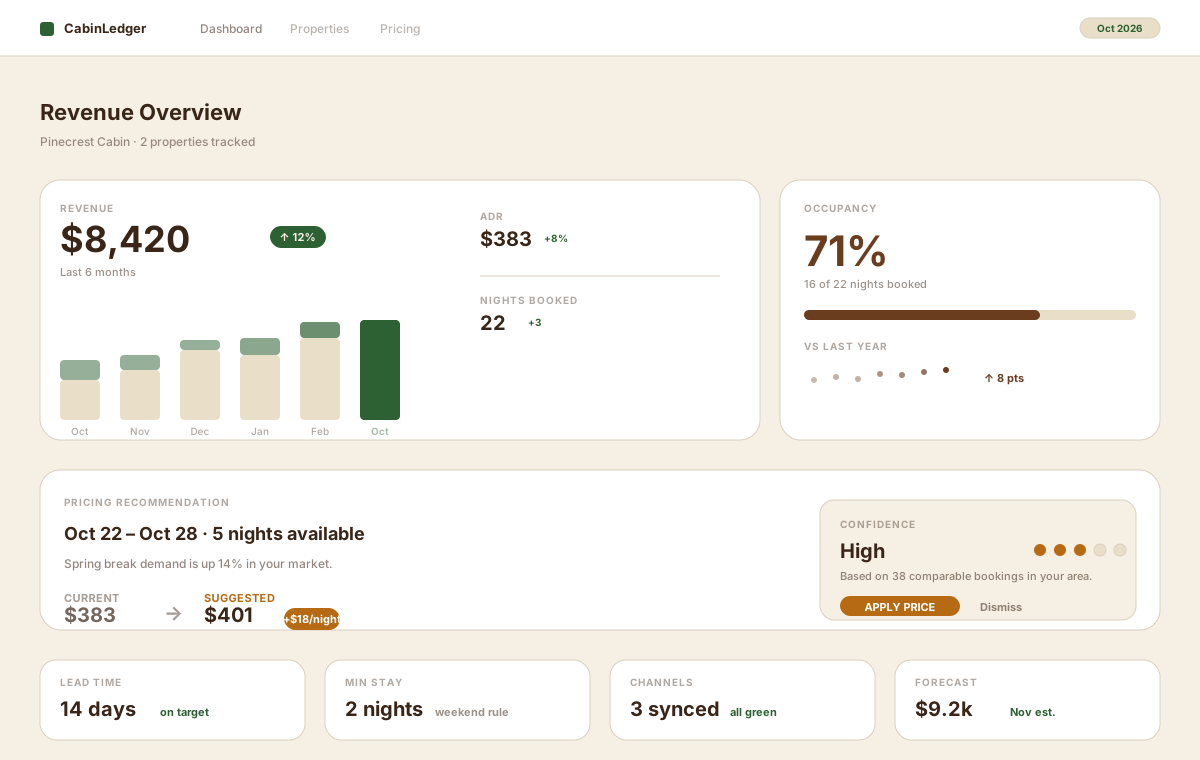
This guide is built around a single visual hook — a per-channel dashboard. It is the view that makes the channel-mix strategy legible at a glance: Airbnb, Vrbo, Direct, and Booking.com each gets its own revenue column, and you can immediately see which bucket is winning, which is starved, and which is leaking margin to platform fees.
1. What "Channel Mix" Actually Means
Channel mix is not "where my bookings came from this year" — it is the proportion of revenue (and ideally net revenue, after platform fees) that each channel contributed. The four channels every short-term rental cabin is selling on are:
- Airbnb — the broadest distribution, fastest review momentum for new listings, and a guest-paid fee model that is now shifting to host-only (around 3%) on the host's side of the rate.
- Vrbo — the family/cabin-skewed audience, often higher ADR but lower booking velocity than Airbnb, with commission in the 5–8% range depending on whether you are on the subscription or pay-per-booking tier.
- Booking.com — the OTA with the deepest international reach and the highest commission (typically 15–18%), but a strong fill source for shoulder-season mid-week dates where Airbnb and Vrbo are quiet.
- Direct — your own website, channel manager, or simply repeat-guest repeat-booking email. Commission is near zero (you eat payment processing and a small channel-software fee you control), and the customer relationship is yours.
Every channel has a different fee structure, a different guest profile, and a different cancellation-risk profile. Read together as one "rental income" total, they cancel out into a number that is hard to act on.
2. Why Per-Channel Tracking Matters — The Fee Drag
The most common reason cabin hosts stay on a single platform is that it works — bookings arrive, payouts arrive, the spreadsheet adds up. The most common reason cabin hosts with strong revenue are not getting ahead is fee drag they cannot see. Rough host-side commission as of 2026:
| Channel | Host-side Commission / Fee | Net of $200 Nightly |
|---|---|---|
| Airbnb | ~3% host-only fee (plus ~14% guest service fee charged to guest) | $194 |
| Vrbo | 5–8% commission (subscription or pay-per-booking tier) | $184–$190 |
| Booking.com | 15–18% commission | $164–$170 |
| Direct | ~0% commission + ~3% card processing | ~$194 |
The same property, the same night, the same $200 listed rate, yields materially different take-home depending on which channel the guest found you on. A property that books 80% of nights on Booking.com and 20% direct can be earning less net than a property with the inverse mix — even when gross revenue looks similar. Per-channel tracking is what makes that visible.
3. A Healthy Channel Mix by Lifecycle Stage
There is no single "right" channel mix. The healthy spread depends on how long your listing has been live, how brand-led your destination is, and how much direct-booking infrastructure you have built. Three reference lifestyles:
- New listing (<12 months live) — Airbnb-dominant, typically 60–80% of revenue. The platform's distribution is fastest and first-review velocity matters most. Vrbo and Booking.com usually trail. Direct is often under 5% because there is no search traffic to your own site yet.
- Established listing (1–3 years) — a more balanced spread settles in: Airbnb 40–55%, Vrbo 25–35%, Direct 10–20%, Booking.com 5–15%. Vrbo grows as reviews accrue (Vrbo guests weight reviews more heavily than Airbnb guests).
- Brand-led listing (3+ years, weak-area destination with a recognizable name) — Direct typically pushes to 25–40%, diluting Airbnb/Vrbo/Booking.com accordingly. Direct is the highest-margin channel and the one worth building toward once your listing has its own pull.
Use these as reference points, not targets. The right mix for your cabin is the one that maximizes total net nightly revenue — not the one with the highest single-channel share.
4. How to Grow the Channels You Are Underweight On
The move for any underweight channel is to fix listing-quality first. Budget and inventory help, but a weak listing on three channels is what most cabin hosts are actually running. The lever set by channel:
- Airbnb & Vrbo — match each platform's minimum photo count, reply to first inquiries inside one hour, and converge nightly rates so the same dates do not show a $40 gap between platforms. A guest searching both will book whichever is lower.
- Direct — the lever is a direct-booking website tied to a Google Business Profile for your cabin's address, plus a small repeat-booking or unique-booking discount (often 5–10% below the platform rate) that pays for itself in saved commission within two bookings.
- Booking.com — apply for OTA visibility programs (Visibility Booster, Preferred Partner) once you have 5+ reviews and meet stay-quality thresholds. The OTA's surfacing algorithm favors listings with fast confirmation and consistent review scores.
Before growing any new channel, run the revenue-math test: would a same-night same-dates booking land on this new channel, or would the same guest have booked the channel I already have? If the answer is mostly "they would have booked Airbnb anyway," the new channel is mostly incremental inventory cost, not new demand.
5. Tracking It Without Spreadsheets
The honest reason most cabin hosts do not have a channel-mix number is that pulling it out of a spreadsheet is annoying. Each platform exports differently, the payouts do not arrive on the same day, fees sit on different rows, and "annual rental income" is the easier column to look at. It is also the column that hides the most action.
CabinLedger's per-channel dashboard breaks out Airbnb, Vrbo, Direct, and Booking.com revenue into separate columns on one page — so you can see at a glance which channel is winning, which is starved, and which is leaking margin to fees. Net figures are computed automatically (rate minus host-side commission), so you are comparing economics, not gross headlines.
Once you can see the four buckets, the next move is obvious: pick one underweight channel, run the listing-quality fixes that match it, and re-check the dashboard four to six weeks later. That is the loop that grows revenue.